USPTO Patent Rule Changes 2026
When reading the news about how the USPTO has "tightened patent rules" in 2026, please note that this is a much more specific change, though it is no less important. It refers to the USPTO new patent rules 2026, which became effective from 13, 2026. Specifically, this regulation affects only those petitions that concern unintentional delays.
As of now, according to the new rule, the USPTO requires more detailed description of the delay and the increased fee for such a petition from the moment when the delay exceeds one year instead of two years. This is not a revision of US patent law at all. The normal filing requirements, examination requirements and patent drawing requirements remain as before. Further, we will analyze these changes in more detail.
The USPTO has established in the Federal Register through a final rule on June 24, 2026 (91 FR 37826) entitled "Conditions for Additional Information and Fee in Petitions Filed in Patent Applications and Patents Based on Unintentional Delay". The final rule took effect on 13, 2026, according to its official text and applies to any petition filed after the date of effectiveness.
The rule makes two related changes:
The additional information threshold decreased from two years to one year. Following a notice issued by the USPTO in March 2020, petitioners had been required to provide additional information when the petition for an unintentional delay was filed within more than two years since the applicable date. This period is reduced to one year.
The increased petition fee threshold decreased to one year. This time, the petition fee under 37 CFR 1.17(m)(1) will be paid for a petition filed more than one year after the action was to be taken. According to the USPTO, the amounts of fees were not changed.
The meaning of additional information. Each such petition must include a statement that the entire delay is unintentional. Moreover, when a petition is filed after the expiration of the one-year period, the petitioner must provide an explanation of the facts of the situation that proves that the entire delay is unintentional. Thus, in order to prove an unintentional nature of the delay, a certification alone will not suffice after one year. The USPTO requires additional facts.
It should be noted that the one-year period does not constitute a safe harbor. The USPTO has retained the right to require additional information in any case when there is a doubt as to the unintentional nature of the delay.
The submission of patent applications and issuance of patents is governed by deadlines. Failure to file a timely reply to an Office Action results in abandonment of the application. Failure to pay the required maintenance fee, including the grace period of six months, causes expiration of the patent. Failure to claim the priority of an earlier filing results in losing the earlier filing date.
Under federal patent laws, USPTO may provide relief where the failure was unintentional. The petitioner completes the required act (such as a reply or the fee that is overdue) and files a petition, pays the required fee and states that the failure was unintentional.
There are two issues that tend to confuse people. First, the "entire delay" includes all the time between the due date and the filing of a grantable petition, not only the first missed deadline. Secondly, a deliberate act to abandon an application cannot be considered unintentional, even if the petitioner changes his mind later. In routine cases, USPTO takes the statements at face value based on its reliance on the duty of candor of the petitioner. This rule changes that practice as of 2026.
Petitions affected by the rule include:
| Requirement | Previous position | 2026 position | Practical impact |
|---|---|---|---|
| Additional explanation of the delay | Required if petition filed more than 2 years after the relevant date | Required if petition filed more than 1 year after the relevant date | More petitions need a detailed, fact-based explanation |
| Higher petition fee, 37 CFR 1.17(m)(1) | Applied after 2 years | Applies after 1 year | The higher fee is reached a year sooner |
| Fee amounts (per the rule's fee table) | $600 micro / $1,200 small / $3,000 other | Unchanged | Same cost, earlier trigger |
| Hague international design applications | Not among the three circumstances in the 2020 notice | Expressly included in the one-year threshold | Design applicants filing via Hague are covered |
| USPTO discretion to request more information | Any time a question arises | Unchanged | Filing within one year does not guarantee routine treatment |
| Patentability standards and drawing rules | Not addressed | Not changed | Normal prosecution continues as before |
These applicants will be lucky enough to never experience this type of change, but this is especially important for those who find out about their deadline problems much later on. Here are some scenarios that you should keep in mind:
In case your petition is timely, meaning it was filed within a year of the deadline, then the standard declaration would apply in most cases.
The reasons for the modification were provided in the rule itself. Specifically, the rule aims at the following:
Increasing certainty and predictability of the rights under patents. The USPTO asserts that the longer the delay period is, the greater the chance that the entire period of delay is unintentional.
Providing protection for the public. Third parties and competitors may count on the assumption that the application is already abandoned or the patent expired. Resurrection of the rights will interfere with the reliance of the third parties.
Promoting timely measures. The USPTO refers to its initiative regarding the reduction of pendency and encourages the applicant to timely fix the problem.
Covering the expenses. Due to the necessity of additional information to be provided, the petition requires additional examination which implies more costs for the USPTO to recover.
In addition to the general purpose of the rule, it refers to the decision of the US Federal Circuit Court of Appeals dated 2018 (Rembrandt Technologies) when the patents were deemed to be unenforceable due to the inaccurate statement about unintentional delay. There is no statistical information available in the rule regarding the number of petitions filed after one year.
The primary source of confusion is the following, which is helpful to disentangle into three categories:
Indirectly, there is no question but that the consequence is simply more costly to cure missed deadlines.
No. This 2026 rule does not amend any drawing requirement of patents. It modifies the petition fee requirements for 37 CFR 1.17(m)(1) and the petition procedure of the USPTO. The drawing requirements for 37 CFR 1.84 and design drawing requirements for 37 CFR 1.152 are not included in this rule.
Compliance with the drawing requirement is still important for its own sake. When the drawings of a utility or plant patent application do not meet the publication requirements, a Notice to File Corrected Application Papers with a two-month extendible response period is issued by the USPTO. Drawing deficiencies could be raised as objections in the Office Action. A USPTO notice that goes unanswered can result in abandonment. And abandonment is precisely when the new one-year period comes into play.
These requirements have been taken from current USPTO requirements as stated in 37 CFR 1.81 to 1.84, 1.121, and 1.152:
Quality of lines. Generally, black-and-white drawings are required. The lines must be dark enough and sufficiently thick and solid in order to reproducibly be reproduced (37 CFR 1.84(a) and (l)).
Numerals. Numeral should be simple, readable, and be not less than 0.32 cm (1/8 inch) high. The same reference character should be used for each occurrence of the part, and any reference character in the drawings should be referred to in the specification and vice versa (37 CFR 1.84(p)).
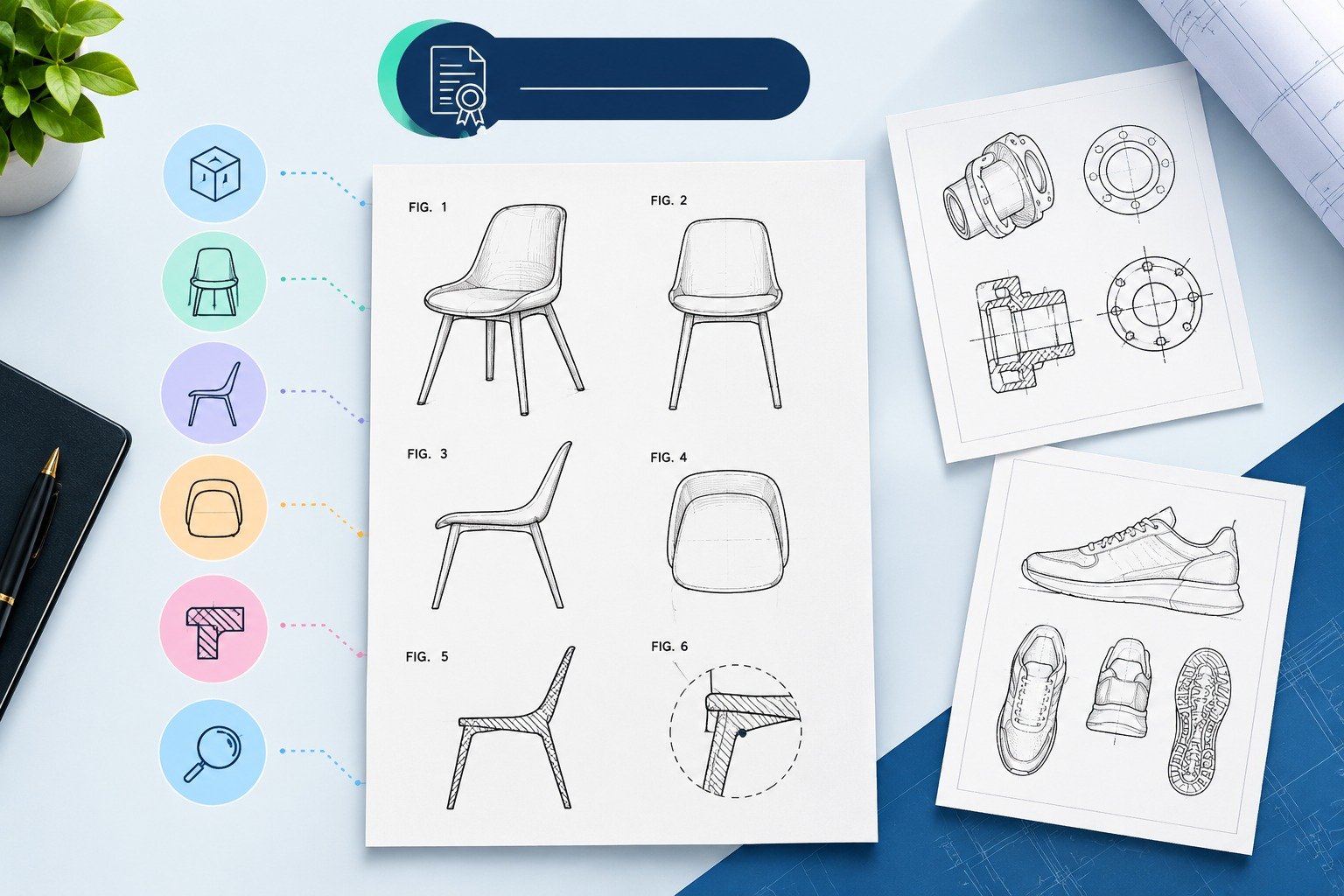
Sufficient views and correct numbering. As many views as needed to disclose the invention shall be provided and should be numbered consecutively, for example as FIG. 1, FIG. 2, etc. (37 CFR 1.84(h) and (u)).
Conformity with the specification and claims. All features described in the claims shall be shown in drawings (37 CFR 1.83(a)).
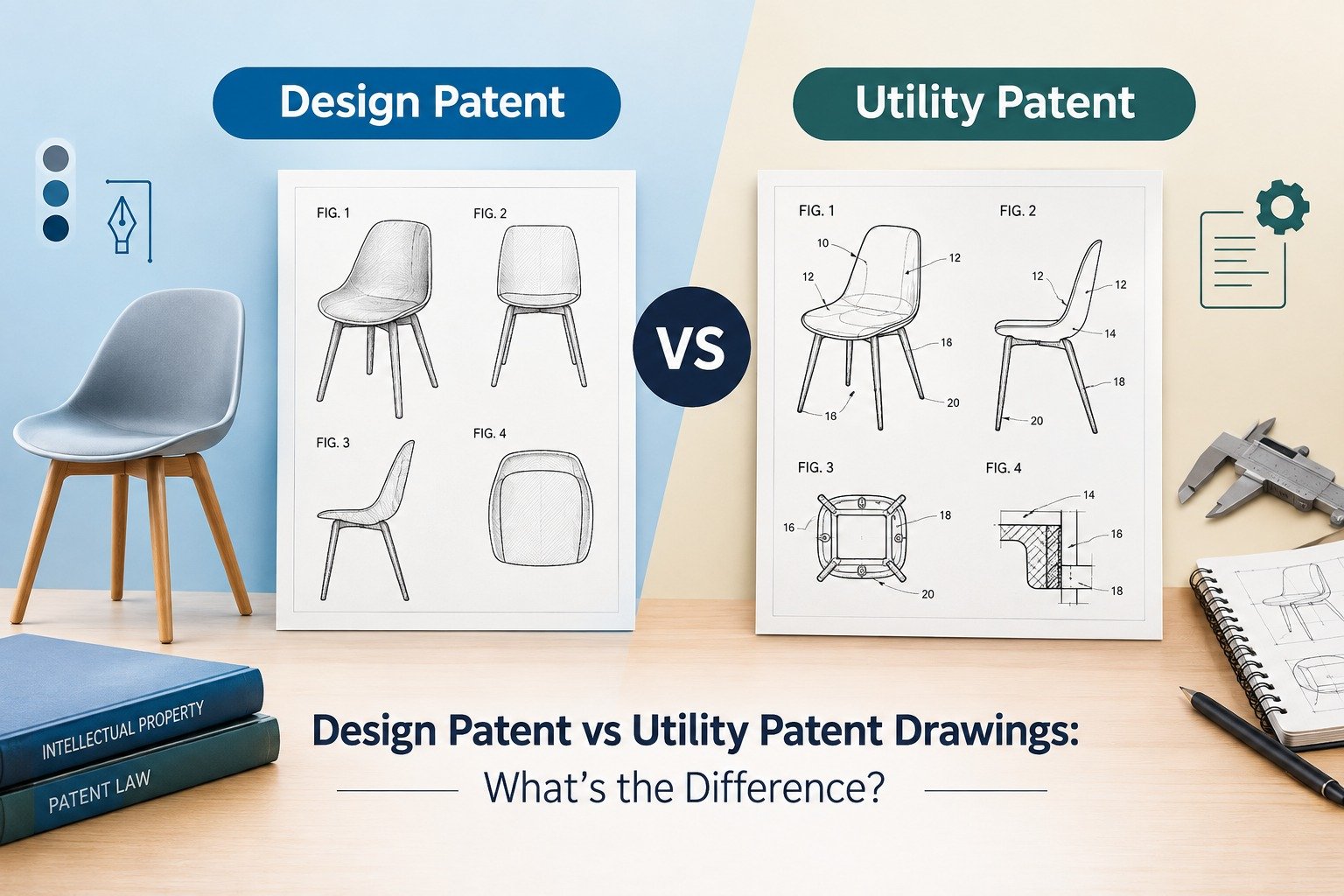
Completeness of the drawing in design patent applications. Drawings in design patent applications disclose what is claimed. Sufficient number of views is needed in order to disclose fully appearance of the design (37 CFR 1.152).
Format of sheet. Sheets on which drawings will be presented have to be 8.5 × 11 inches or A4 sheets with required margins (37 CFR 1.84(f) and (g)).
Replacement sheets. Replacement sheets should bear designation "Replacement Sheet" and contain all figures from the original sheets, and cannot introduce new matter (37 CFR 1.121(d)).
Below are some practical recommendations, but not legal requirements or legal advice:
The 2026 rule pertains to petitions rather than drawings. However, a properly prepared application reduces the number of reasons that may prompt the USPTO to issue notices, and each notice not issued is one more deadline to worry about.
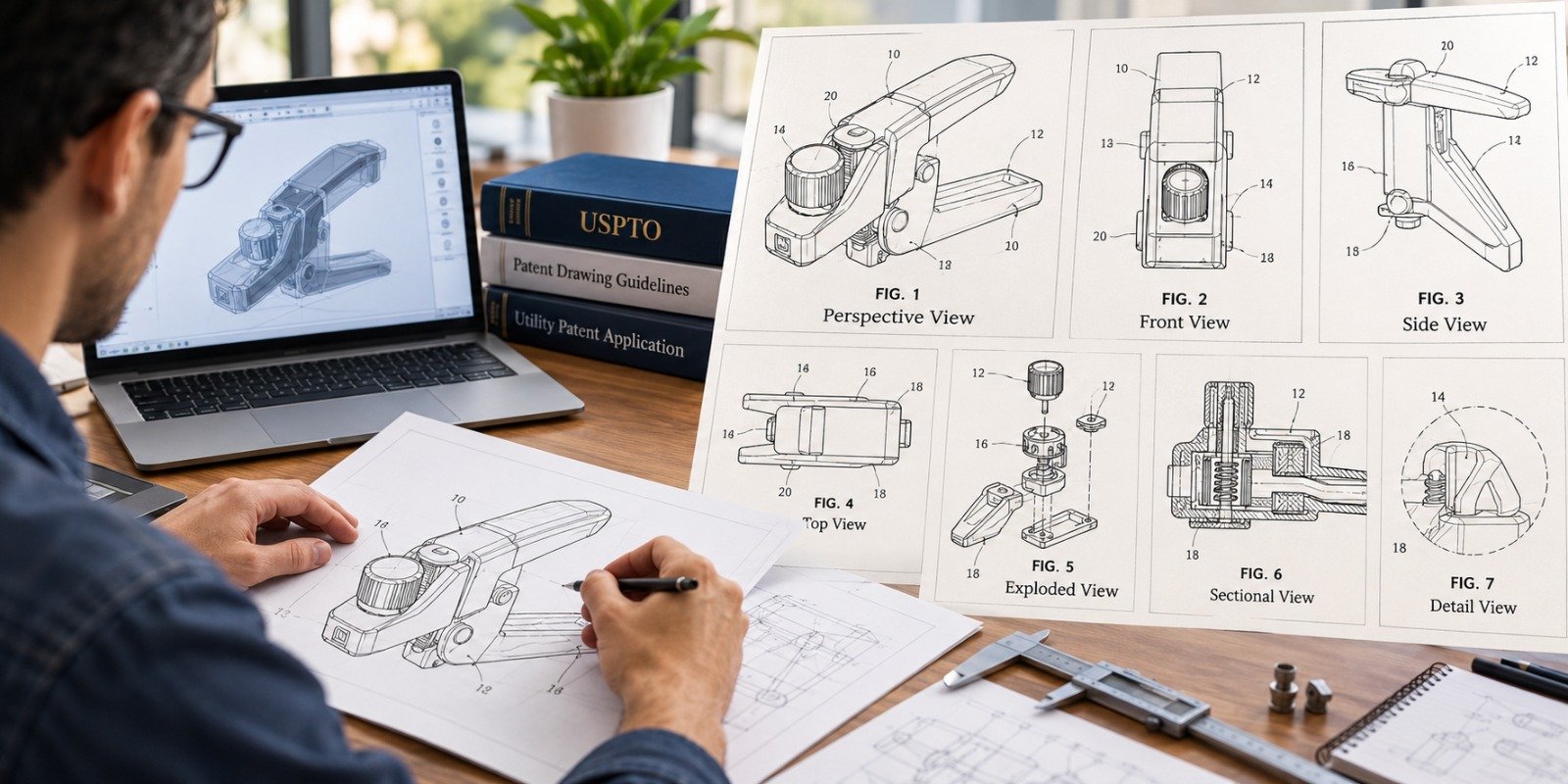
Our company provides patent drawing preparation services for patent attorneys, patent agents, companies and independent inventors. We provide drawings based on initial sketches, pictures, CAD data, and other figures according to the required USPTO rules and guidelines, and we check reference numbers against your specification. The following services are provided:
Utility patent drawings illustrating the structure, function and operation of an invention
Design patent drawings with all required views and shading to describe the ornamental design
Replacement and corrected drawings for patent applications which have already been objected to for drawings or were issued the notice to file corrected papers
Trademark drawings for marks
We work under non-disclosure agreements and provide our clients with revisions, enabling them to reconcile the drawings with their specification prior to filing. Professional drawings cannot ensure that a patent will be granted or there will be no objections. However, professional drawings will allow the invention to be represented clearly and properly in compliance with relevant drawing rules.
USPTO New Patent Rules 2026 is limited in scope and process-based. For all petitions filed on or after 13, 2026, a delay of greater than one year in restoring the application, making a late maintenance fee payment, filing for priority or benefit, or waiving a missed deadline under the Hague Agreement shall require a justification and increased petition fee. The usual application process, examination process, and the drawings remain the same. The key point here is to stay on top of your paperwork, be prompt, and organize your entire application right from the beginning.
An additional description of delay is required in petitions for unintentional delay for those petitions submitted later than one year from the relevant date if such petitions are filed after 13, 2026. Previously, the threshold date was two years.
No. The rule change only affects petitions based on unintentional delay. The USPTO says that there have been no changes to substantive patentability criteria and filing requirements.
It applies when the petition is submitted later than one year from the following dates: date the application was considered abandoned, expiration date of the patent, deadline for priority/benefit claims, and relevant deadline set by the Hague agreement.
Applicants or patent owners submitting petitions to revive abandoned applications, accept late maintenance fees, accept delayed priority/benefit claims, revive reexamination proceedings, and excuse delay in fulfilling Hague requirements if the petition is submitted later than one year from the relevant date.
No. There is no change to the requirements set forth in 37 CFR 1.84, 37 CFR 1.152, or any other rules related to drawings. Drawing requirements continue to be important regardless because an outstanding drawing notice may cause abandonment of the application.
The application may become abandoned or the patent may expire. In case of unintentional delay, the petition may help. Starting one year after the relevant date, an explanation of delay is required and there is a higher fee; however, the USPTO may deny the petition if there is no proof of unintentional delay.
Yes. Replacement sheets labeled "Replacement Sheet" according to 37 CFR 1.121(d) are submitted.
They can review the final rule published in the Federal Register (91 FR 37826), 37 CFR Part 1 available in eCFR, the USPTO fee schedule, and the Manual of Patent Examining Procedure. The USPTO says that the MPEP will be updated accordingly.
Legal disclaimer (to be placed at the end of the published article): This article is intended for general information purposes only and is not a substitute for legal advice. The patent applicants should consult a qualified patent attorney or patent agent.

At “The Patent Experts” our team specialises in turning complex concept and ideas into exact complaint patent drawings that meet the stringent guidelines of USPTO, EPO, WIPO among other major patent offices around the globe. With over 5+ years of experience, our team of skilled illustrators are efficient in producing high quality utility designs and trademark patent drawings. By combining cutting-edge technology with a deep understanding of global patent regulations, we ensure every drawing we create is ready for seamless submission and approval.
Quicks Links
Get in touch
Our phone number
Our email address
© 2026 The Patent Expert's All Rights Reserve
Made with ♥ by Website99