Design Patent vs Utility Patent Drawings: What’s the Difference?
When preparing and filing a patent application, you probably know that the written description is not the only thing you need to do properly. In many cases, the drawings, or simply put, the pictures of your invention, can be as important and valuable as the description. In particular, the difference between the design patent drawings and utility patent drawings should be clear, otherwise, your application can be rejected or result in an office action, which will cause delays and cost money. Here, we will tell you more about these differences, how to prepare drawings correctly, and what to pay attention to in order to make everything right. Whether you are an independent inventor, a startup founder, or simply interested in the topic, this article can be useful for you.
First, it makes sense to talk about why patent drawings are so significant.
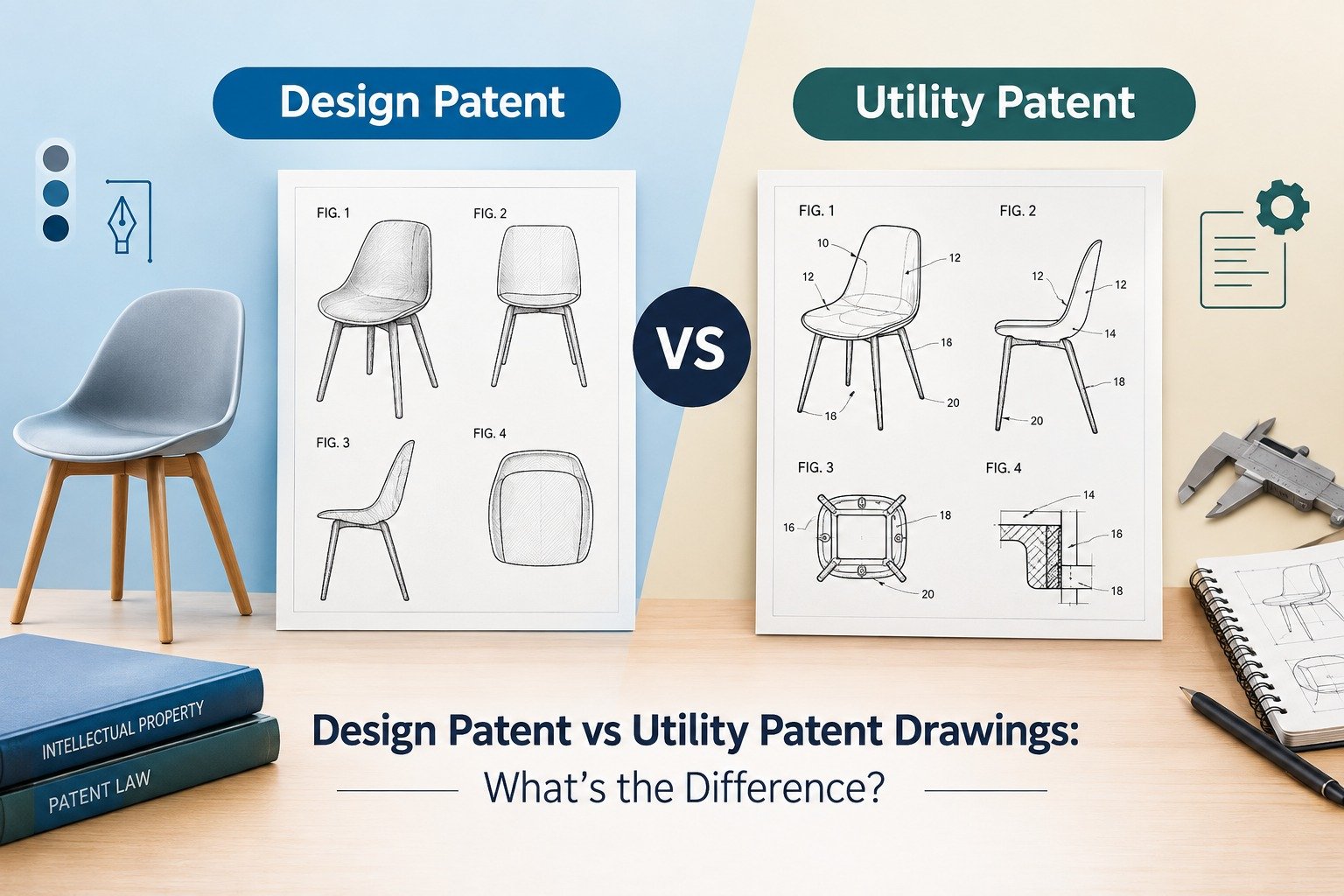
There are two types of patents – utility and design. In case of the former type, the claims describe the scope of protection; in case of design patent drawings define the scope of protection. As it was mentioned above, there is a difference between design and utility patent applications: in the case of utility patents, the written claims define the scope of protection; in case of design patents, the drawings do this. The absence of description is the main reason for most differences between design and utility patent drawings – once you understand this basic point, everything else becomes clear.
A utility patent is a type of patent that covers how something works (its function, mechanism, structure, or a process). For example, a hinge, a water purification system, the device controlled by the software, or a special manufacturing process. This is the most popular type of patent filed in the US. The term of protection of the utility patent is 20 years from the filing date.
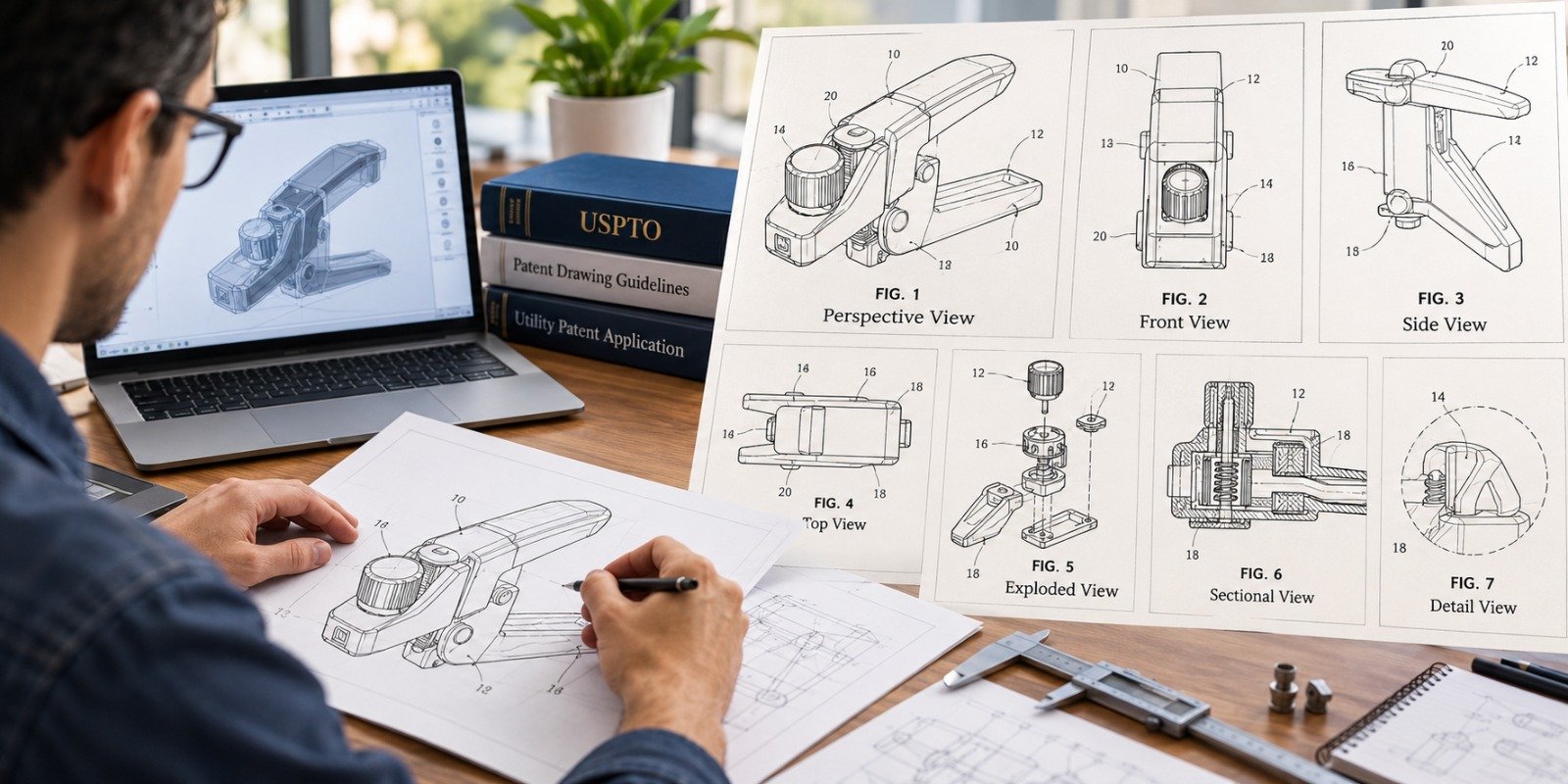
The purpose of the utility drawings is to help the patent examiner (and in case of litigation, judges or competitors) to understand the structure and function of your invention in addition to the written description and claims. The USPTO guidelines state that according to 37 CFR 1.84, utility drawings shall show all features described in the claims and be so descriptive that someone familiar with the relevant technology can understand the structure and operation of the invention after viewing them together with the description of the invention.
Since utility drawings are only supplementary to the written description, examiners have a bit of leeway to interpret them in conjunction with the specification. An absent or unclear feature of the drawings can be explained by means of the written description in many cases – but not always, especially for the features described in the claims.
A design patent is a type of patent that covers the ornamental appearance of an article, i.e., its shape, surface pattern, configuration, or visual impression. The operation of the invention is not covered. For instance, the unique shape of the smartphone, the pattern of shoe sole, or the silhouette of a bottle belong to design patents. The term of protection for the design patent is 15 years from the date of grant (not from the filing date). Unlike the utility patents, design patents have no maintenance fees.
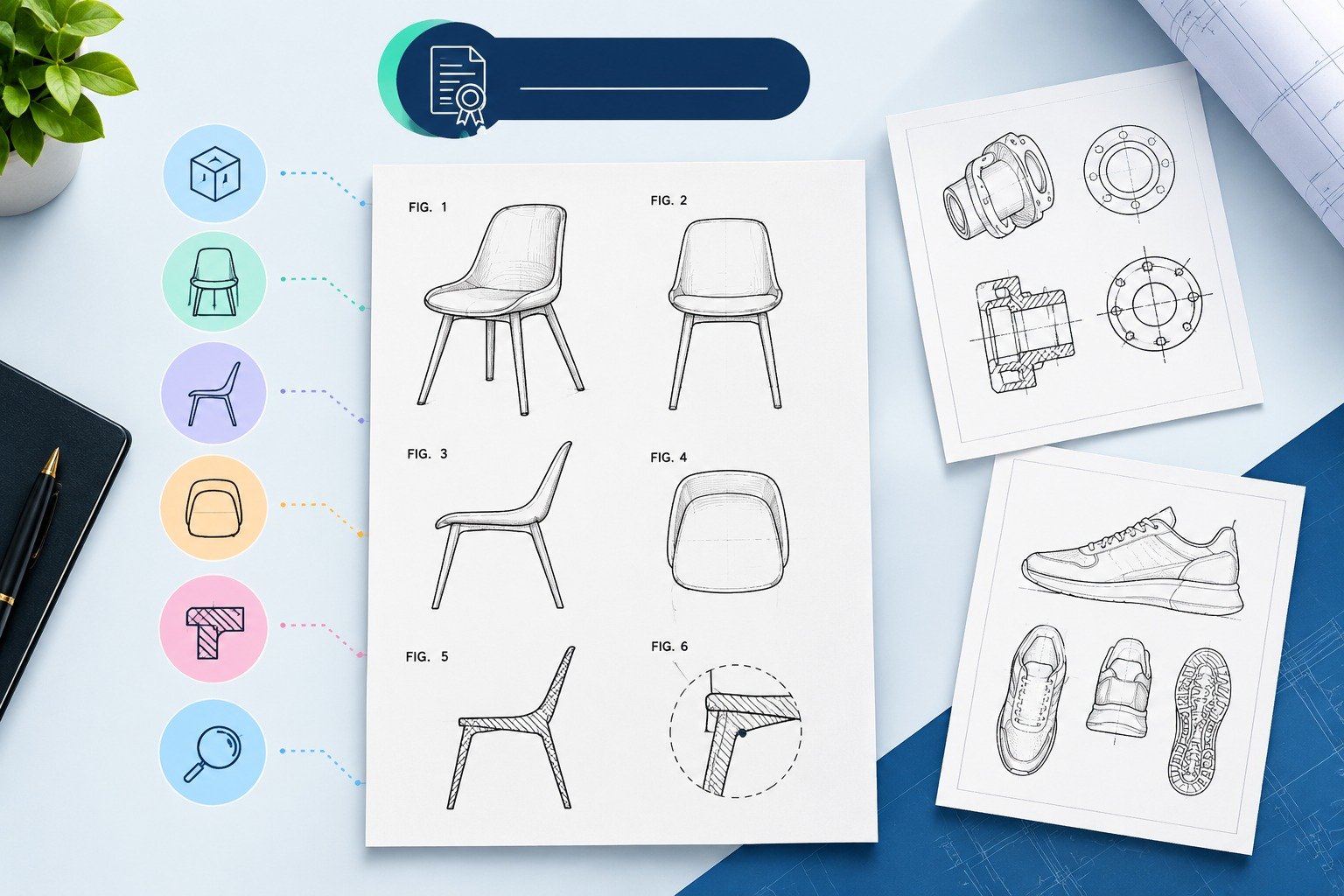
Now, pay attention to this: in a design patent application, drawings are the invention! There is no detailed written description of the design features, as in the case of the utility patent – there is a brief, standardized description stating what each figure shows (e.g., "Fig. 1 is a front perspective view of the shoe"). The drawings are the definition of the scope of the protection of the design patent – all lines, all shaded areas, all dotted outlines.
That's why in the case of the design patents the drawings should be very precise and formally executed, since any mistake in shading, inconsistency of views, or unclear outline can decrease or nullify your protection entirely.
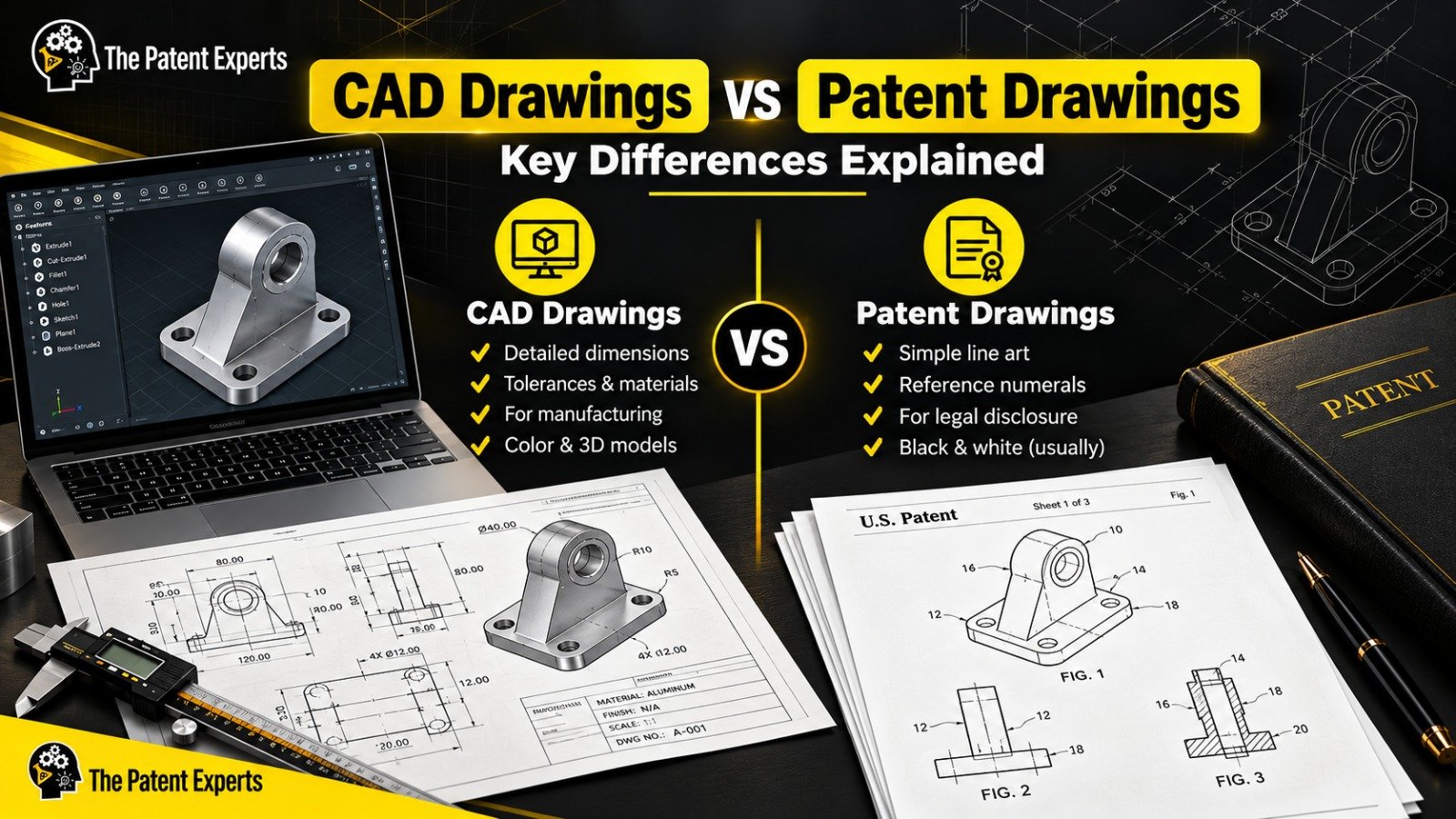
Aspect | Utility Patent Drawings | Design Patent Drawings |
| Purpose | To illustrate and explain the invention functionally | To define the scope of protection of the claimed design |
| Legal significance | Supportive; the claims define the scope of protection | The drawings themselves define the scope of protection |
| What is depicted | Mechanisms, structure, process steps, internal parts | External appearance, shape, surface ornamentation |
| Reference numerals | For each part described in the claims | For figures only, not for the parts |
| Types of lines | Solid lines and hatching for the cross sections | Solid lines (for claimed) and broken lines (for unclaimed or environmental) |
| Shading | Optional, used for clarity | Mandatory in order to show the contours and surface depth |
| Number of views | As many as needed to explain the function | All six orthographic views and perspective in most cases |
| Color/photographs | Forbidden, unless a petition is submitted | Permitted, though in accordance with some restrictions |
| Role of the written description | Detailed description accompanying drawings | Minimal: short figure description only |
| Protection duration | 20 years from the filing date | 15 years from the grant date |
| What it protects | Function and structure | Visual appearance only
|
Imagine you developed a novel type of water bottle, which includes a filtering cartridge inside, and also designed its shape in a unique way. In such a case, it is quite possible that you will want to file both utility and design patents for the same product.
The utility patent drawings will depict the internal filtration mechanism – the housing of the cartridge, the water flow through the cartridge, the sealing mechanism, the threads of the cap – all the drawings will be labeled with the reference numerals and may include cross-sections in order to depict the internal structure.
The design patent drawings will include all six orthographic views of the bottle's external shape, including the shading of the surface in order to depict the bottle's curvature, and the use of the broken lines if, for example, the closing mechanism of the cap is not claimed.
Note that the two different sets of drawings depicting the same physical product differ significantly, because the protection offered differs significantly – one type protects the function, and the other one protects the appearance.
Dual-filing in this way is actually common practice in some product-oriented industries (consumer electronics, footwear, and packaging industries).
After reviewing and preparing many design and utility patent drawings, there are several common mistakes that seem to recur again and again:
Now, it's the part of the information that inventors sometimes overlook: for the design patents in particular, courts have repeatedly stated that the scope of protection is restricted to the drawings only. The ambiguity or inconsistency in the drawings not only causes delays in the examination, but can be used by competitors in order to design around the patent or even invalidate your patent in the case of litigation.
For the utility patents, although the claims define the scope of protection of the patent, courts and examiners often refer to the drawings in order to interpret ambiguities in the claims. Properly drafted and complete drawings can actually strengthen your claim interpretation during the prosecution or litigation, while sloppiness of the drawings can cause misunderstanding to your disadvantage.
And this is the actual reason why the patent professionals emphasize the importance of drawing work so much – it is not about making the drawings look good, it is about defining your invention properly and ensuring the protection of its actual scope of the function or appearance.
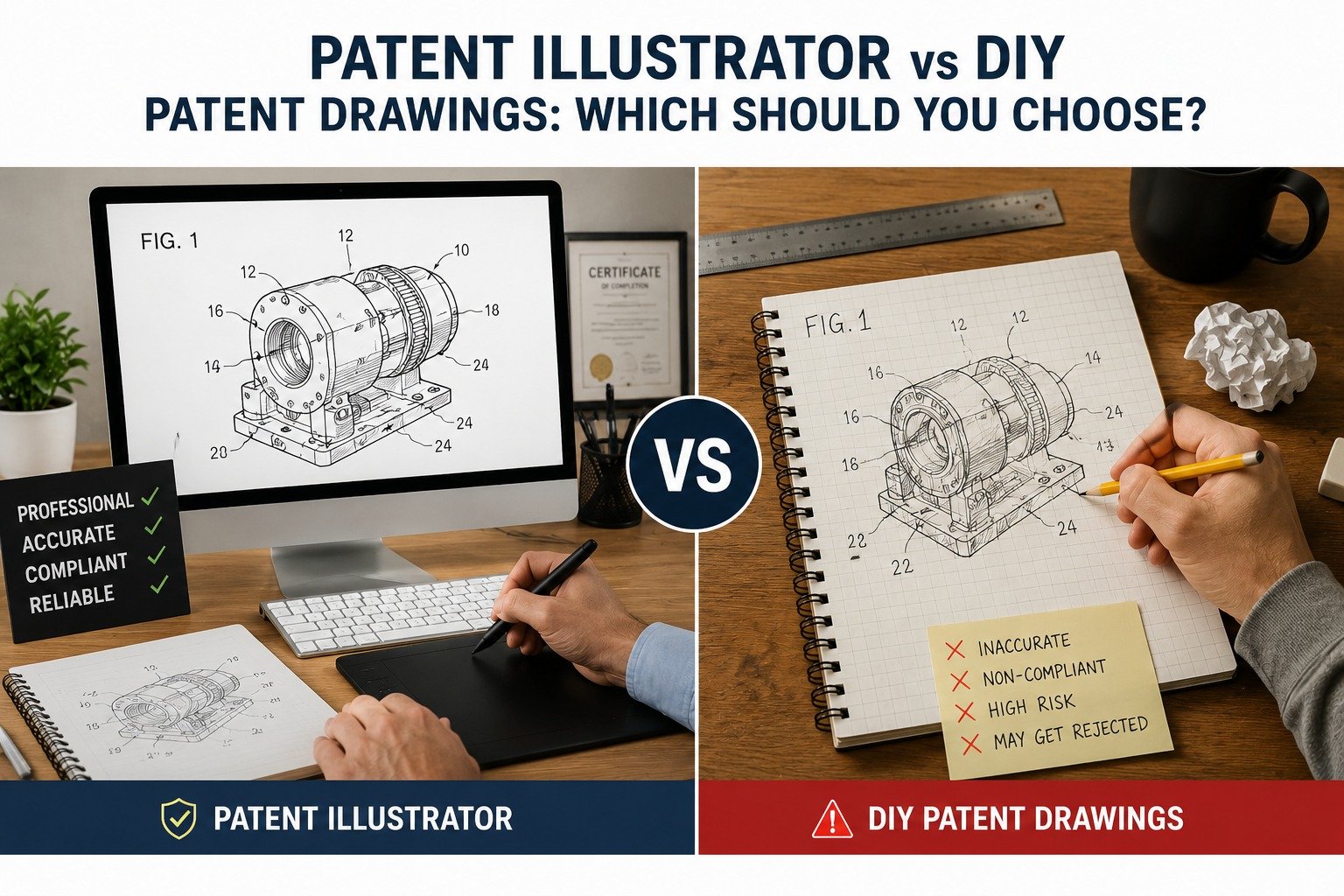
Since the rules for the both drawing types are highly technical, and there are severe consequences for failing to comply with these rules, many inventors (even self-filers) prefer to use services of professional patent illustrators specializing in USPTO-compliant illustrations.
A good patent illustration service usually:
If you file your application in foreign countries as well (e.g. through the Hague System for design patents or the PCT for utility inventions), then the drawing requirements may be slightly different in different jurisdictions – that's why the professional assistance is beneficial in such cases.
Well, generally no, not directly. Although you can file both types of patents for the same invention, the drawings should be created taking into account specific requirements of the patent types – the utility drawing, depicting internal structure and labeled with reference numerals, will not be compliant with the requirements for design patent application, and vice versa.
No, not necessarily. Usually the design applications show the article by itself from all the sides. However, in some cases, it is possible to add a drawing showing the article in the environment (in such case broken lines are used for the depiction of the environment).
Usually you'll receive a notice of non-compliant drawings or office action pointing out the specific reasons for the rejection (missing views, inconsistencies in the line types, wrong reference numerals, or incorrect formatting). Then you will be able to submit your corrected drawings in the specific timeframe provided.
Yes, in most cases: color drawings are allowed only with an approved petition and fee (reserved mostly for biotech or chemical applications), in case of utility patents. In case of design patents, black-and-white drawings or photographs are standard – but in some cases color photographs are allowed too, usually also requiring petition.
Yes, you can, technically speaking – the USPTO doesn't require you to use a professional draftsperson. However, in light of the technical nature of the requirements and legal consequences of improper or non-compliant drawings, especially in the case of the design patents where the drawings define your protection scope, many inventors find that professional illustration pays off. This has a direct impact on the strength of your patent protection, the ease of processing your application at USPTO, and the durability of your rights in case you ever have to use them for enforcing purposes. Regardless of whether you are applying for a utility application for your new mechanism or a design application for your product's unique appearance, putting time (and sometimes, professional effort) into drafting quality drawings is one of the best decisions you can make during the entire patent process.
When you are going to prepare an application of any kind, it may be useful to discuss your invention with a professional who will be able to help you decide which type of drawings you will need and whether you need both types of drawings or only one.
How many drawings are needed for a design patent application?
A certain number of drawings is not required for all design patent applications. In general, it is recommended that the number of drawings be sufficient for providing a full and adequate description of the design claimed in the design patent application.
What should the utility patent drawings consist of?
The drawings for the utility patent should illustrate the elements of the invention described in the claims, as well as demonstrate the operation of the invention. The type of drawings will depend on the specific invention, but may include perspective views, sectional views, exploded views, components details and reference numerals.
Can broken lines be used in the design patent drawings?
Yes. They can be used to indicate the environment or the portion of an article that does not form part of the claimed design.
Why are consistent views crucial in the patent drawings?
It is very important that the views of the invention and/or claimed design are consistent since they help the examiner better understand the invention or the design without any doubts or confusions. Inconsistency in shape, proportion, reference numerals and features in figures may result in objections or requests for correction of the drawings. Also, the utility patent drawings should use consistent reference characters for the same parts in all figures.
Can the patent drawings be corrected after the filing of the application?
Yes, such corrections may be possible during the patent examination, however, they should comply with the USPTO guidelines and new matter cannot be introduced into the application.

At “The Patent Experts” our team specialises in turning complex concept and ideas into exact complaint patent drawings that meet the stringent guidelines of USPTO, EPO, WIPO among other major patent offices around the globe. With over 5+ years of experience, our team of skilled illustrators are efficient in producing high quality utility designs and trademark patent drawings. By combining cutting-edge technology with a deep understanding of global patent regulations, we ensure every drawing we create is ready for seamless submission and approval.
Quicks Links
Get in touch
Our phone number
Our email address
© 2026 The Patent Expert's All Rights Reserve
Made with ♥ by Website99