Professional Sample Patent Drawings in Massachusetts
When it comes to legally protecting an invention, simply having a strong idea is not enough. The patent application and a critical part of it – the patent drawings – can determine the fate of the entire filing. Massachusetts, a state driven by innovation, regularly files engineering inventions, and these drawings become even more critical.
Many inventors face a common problem. Their concept is brilliant, but the drawings are unclear, incomplete, or do not comply with USPTO guidelines. The result? The patent application is delayed, and therefore, understanding the role of sample patent drawings in Massachusetts becomes very important to fill this gap.
Sample patent drawings give inventors a visual guide to help them understand the detail, labelling, and formatting requirements of the USPTO. This kind of sample is invaluable to first-time inventors and startups because it removes the uncertainty. In a competitive innovation ecosystem such as Massachusetts, with the most patent filings,
High-volume professional-quality sample drawings become your ticket to getting noticed.
The Patent Experts are here to help inventors in every stage of the process, working closely to deliver everything from simple sample patent drawings to final USPTO-compliant illustrations.
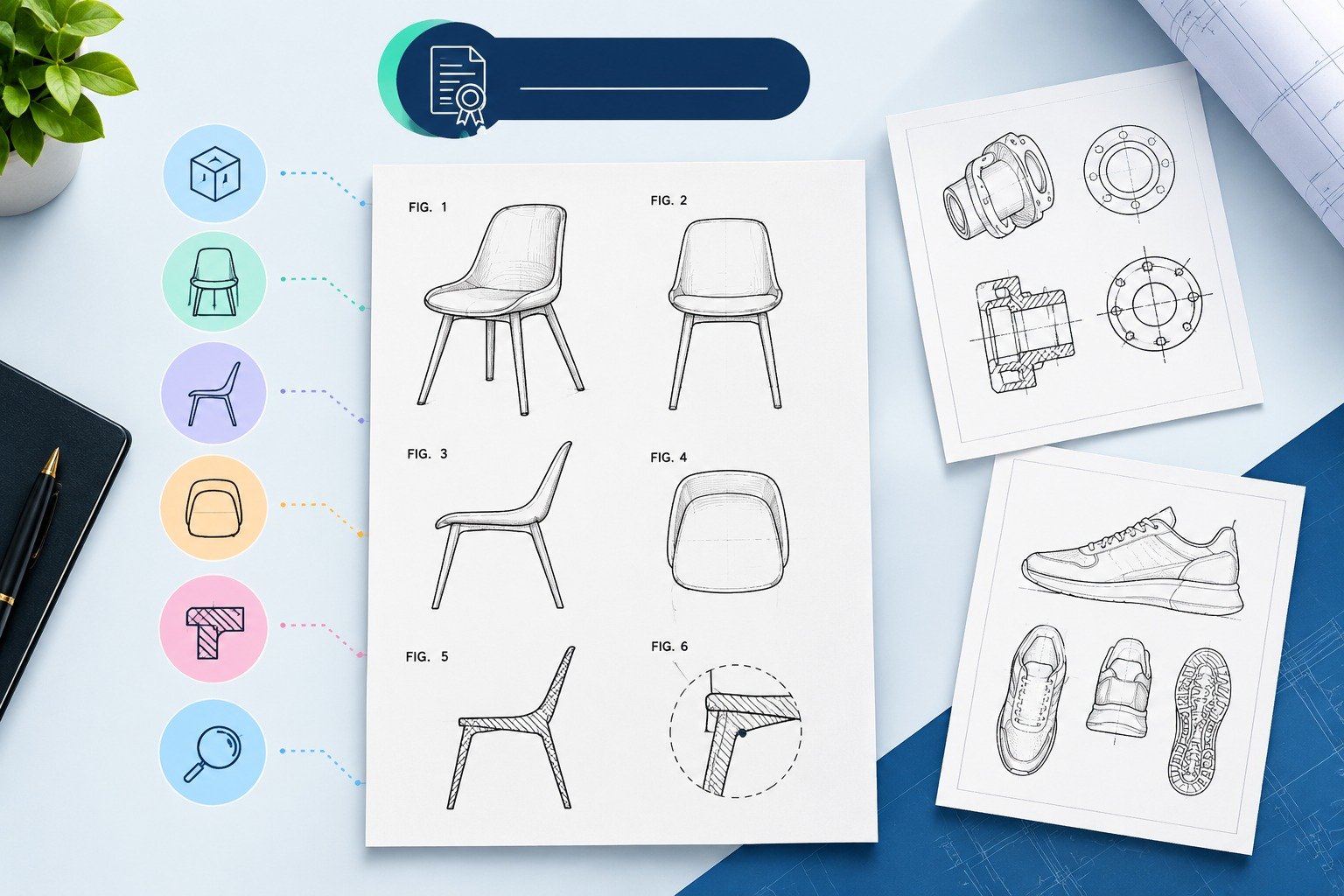
Sample patent drawings are reference illustrations that help inventors understand what a properly formatted patent drawing looks like. These are not the final drawings, but rather a benchmark.
In simple terms:
Many first-time inventors in Massachusetts think that rough sketches or product photos are enough. The truth is that the USPTO requires technical line drawings, and there are specific rules for them.
Sample patent drawings are a great help to Massachusetts inventors because they provide a clear roadmap for how detailed their drawings need to be. The Patent Experts keep these samples very close to real USPTO-approved formats to minimize confusion.
It is essential to us to understand what is going on in the world around us. Massachusetts is home to several great tech and life sciences companies and individuals, but these groups also share many common challenges.
Some of the issues they face:
A biotech startup in Cambridge produced its own patent drawings. Although the concept was strong, the reference numerals in the drawings were inconsistent. The USPTO issued an objection, and the company had to postpone the filing by six months.
These types of situations are not rare at all.
The Patent Experts looked into the matter and found that the delay could have been entirely avoided if the company had used proper sample-based drawings at the time of the initial filing.
This piece of text nicely illustrates that Sample Patent Drawings in Massachusetts are not mere samples but rather risk-mitigating tools.
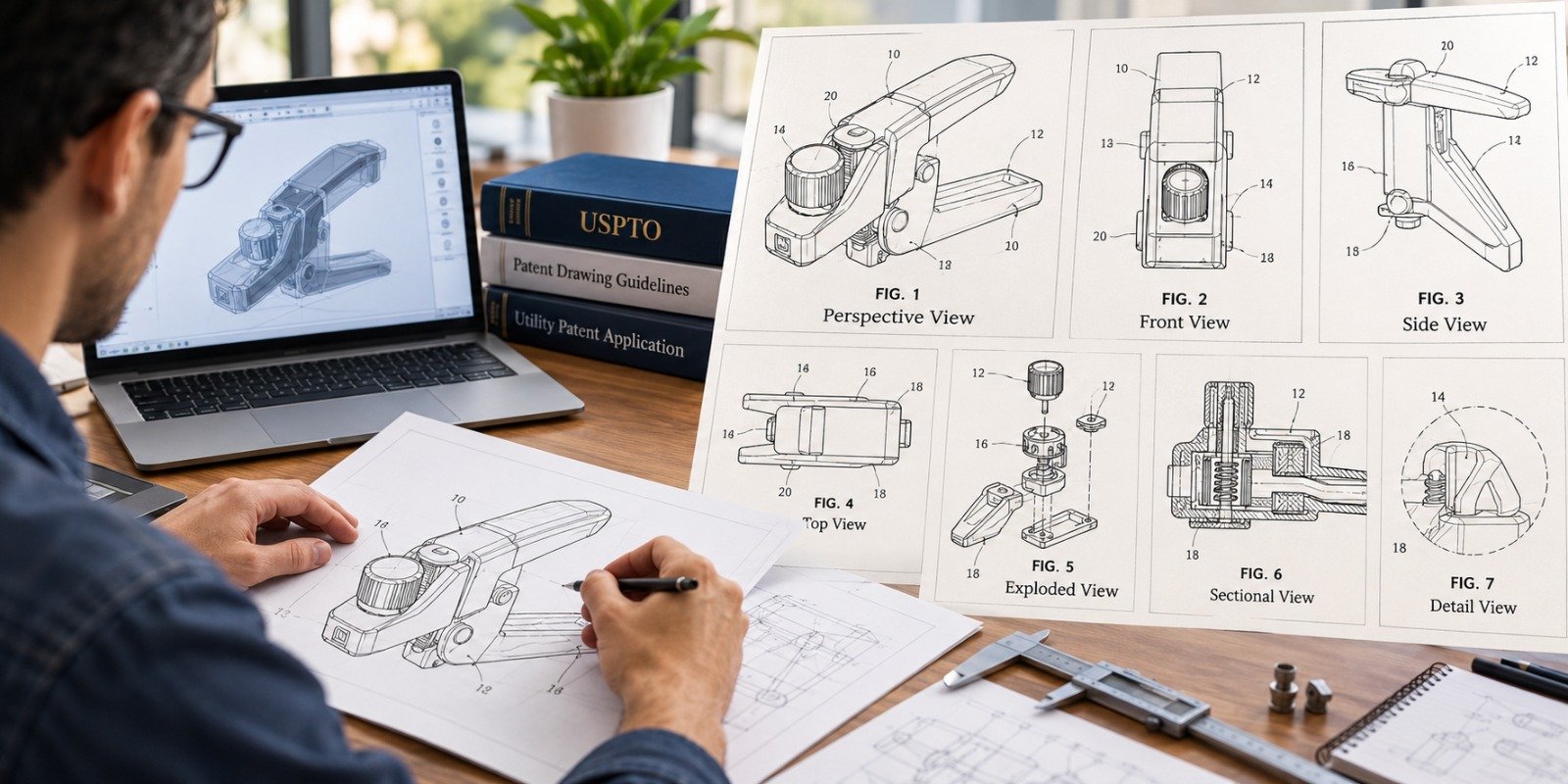
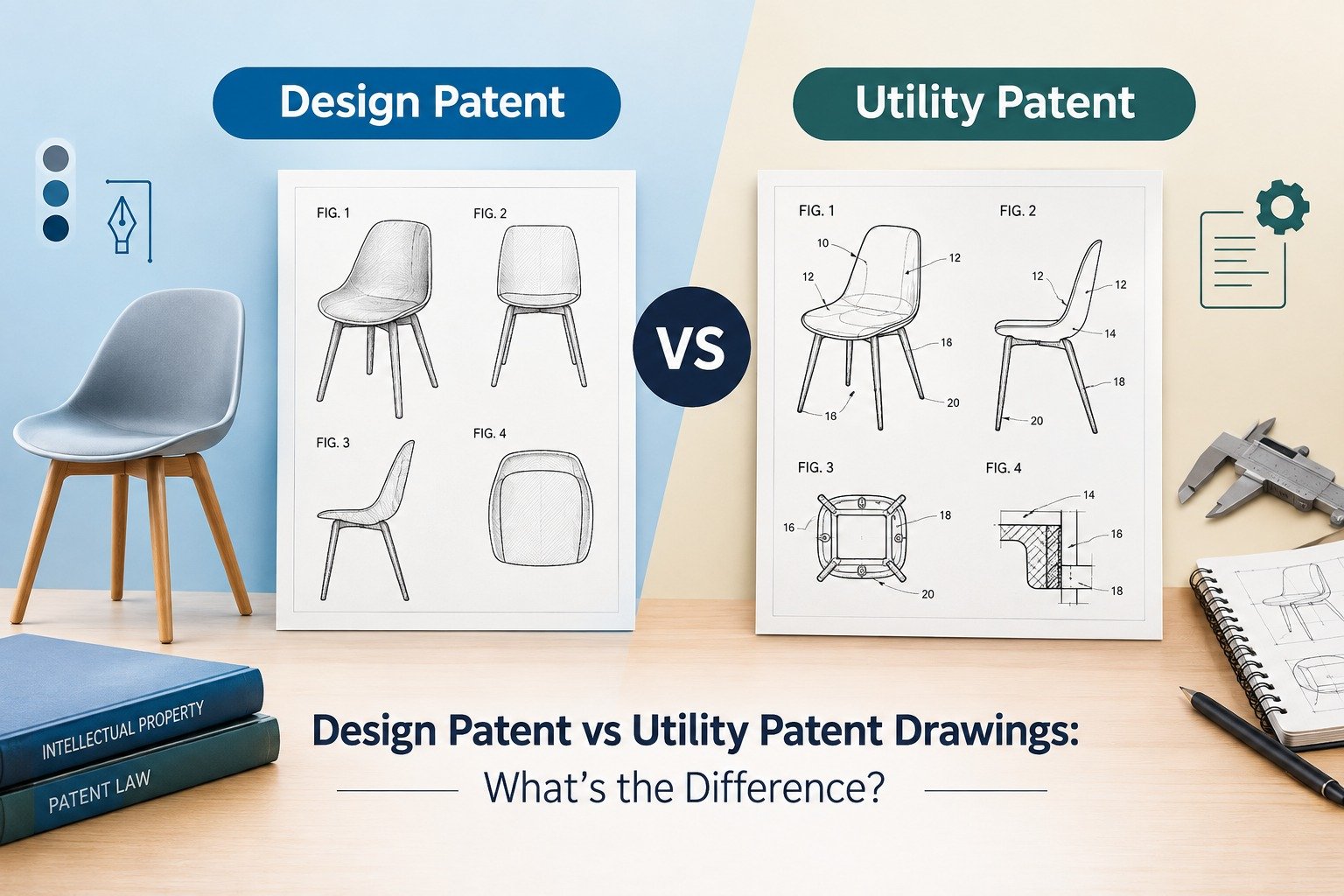
The United States Patent and Trademark Office, or USPTO, has very detailed requirements for patent drawings. The prototype patent drawings are meant to visually express these requirements, so inventors can see what is in line with the rules before submitting the final drawings.
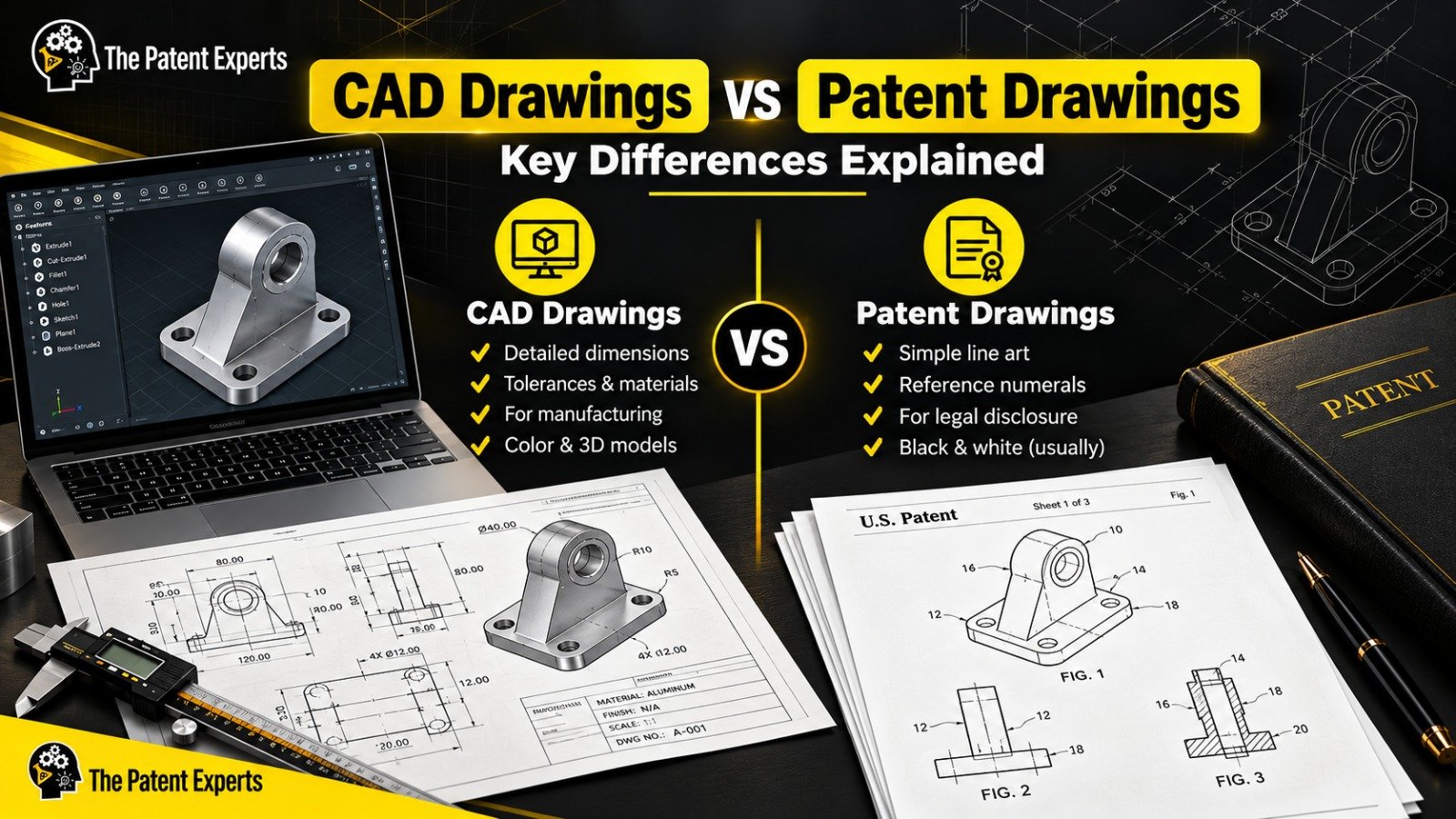
Most of the time, patent drawings must be black-and-white and show figures with clear, solid lines. Only a minimal, special kind of colour drawing may be approved in exceedingly rare cases.
All lines must be fine, even, and free of shading and any other kind of artistic tricks. That is the only way that each element of the invention will be evident to the examiner.
The USPTO has specific margin requirements for each side of the sheet on which the drawing is done. The sample drawings adhere strictly to these layout rules to avoid rejection at the formatting stage.
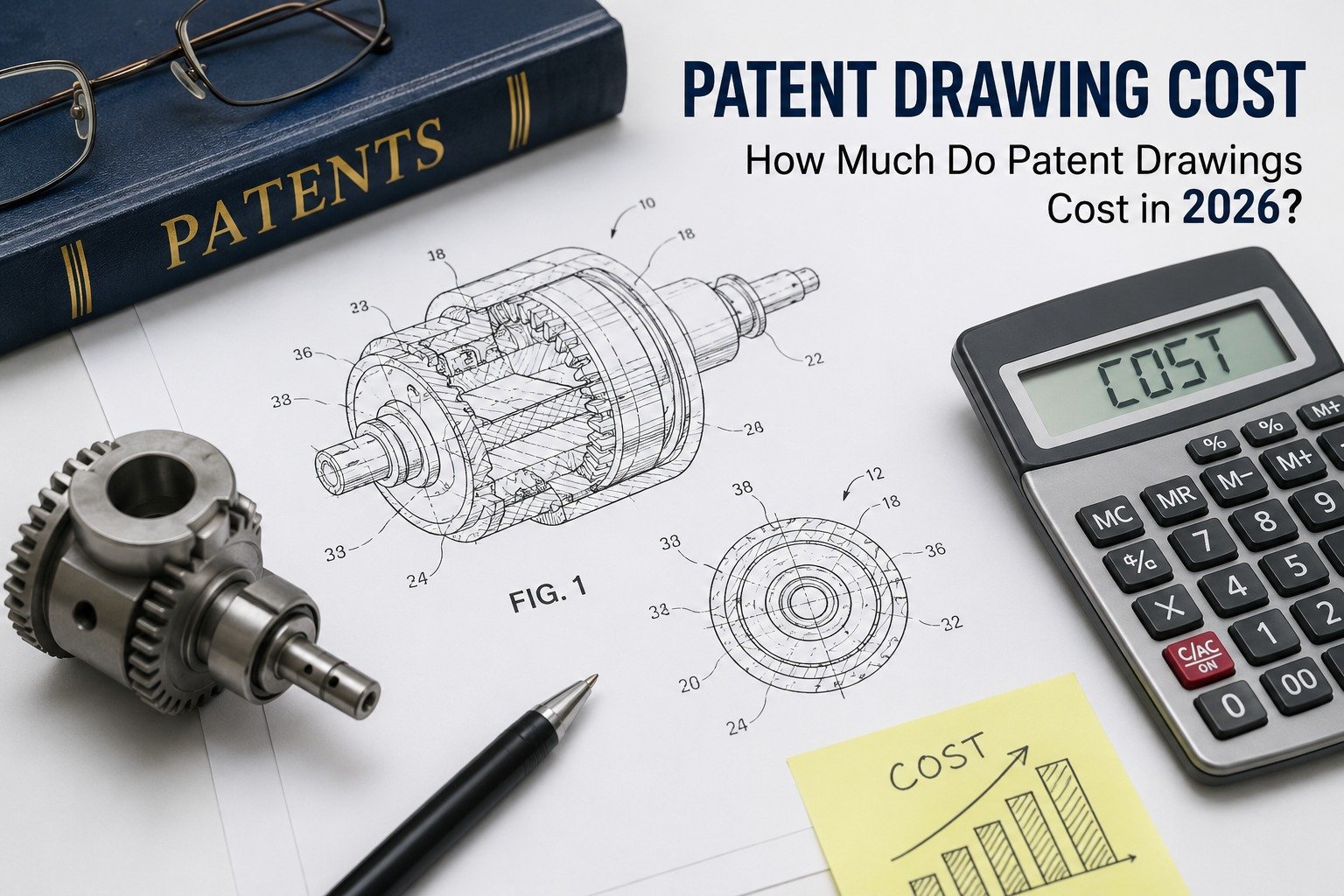
Each component of the invention should be identified with a reference number, and that number should be consistent across all views.
The sample drawings may include front, side, top, sectional, or exploded views to fully disclose the invention's operation.
The drawings are not supposed to have any written descriptions inside the figures, except for short labels if necessary.
Inventors in Massachusetts, especially those working in engineering and medicine, are designing highly complex systems. Sample drawings give them confidence that the resulting submission will be acceptable to the USPTO.
The Patent Experts ensure every sample aligns with real examiner expectations, which significantly increases the likelihood of approval.
Often,inventors confuse sample patent drawings with final patent drawings. They essentially have different roles, but both are very important in the patent process.
Disregarding sample drawings is equivalent to filing your application unthinkingly. It is not wise to take such a risk when you are in a patent landscape like Massachusetts, characterized by both high innovation and high filings.
The Patent Experts help inventors understand the difference between sample and final patent drawings, providing clarity from the start and ensuring high confidence at the time of final submission.
The Patent Experts don't simply make patent drawings; they take a problem-solving approach alongside the inventors. They are not focused solely on the end product, but rather on eliminating risks and making the patent journey smooth for inventors.
The first step is to clearly comprehend the invention - what it is for, how it works, and the level of its technical complexity.
The USPTO-style sample drawings are presented to the inventor to help them visualize the idea and set appropriate expectations.
Before proceeding, the inventor's queries, concerns, and recommendations are taken into account.
The final drawings are created from sample references that strictly adhere to the USPTO guidelines.
Support for revisions is also available if the examiner or the inventor requires any changes.
Numerous startup companies and solo inventors in Massachusetts have completed their patent filings more smoothly, quickly, and stress-free thanks to this sample-based approach. This is why The Patent Experts' process is a trusted solution for inventors.
Choosing the right partner for sample patent drawings in Massachusetts is a crucial decision that can significantly impact the outcome of your patent application. Patent experts offer more than just simple drawings. In fact, they provide a comprehensive support program tailored to the specific needs of Massachusetts inventors and compliant with Patent Office regulations.
Every picture is made by keeping USPTO guidelines at the forefront—right views, clean line art, accurate numbering, and uniform format—so that the examiner will easily get your invention without any doubt.
We support inventors and startups in sectors such as medical devices, biotech, mechanical systems, and advanced manufacturing across Boston, Cambridge, Worcester, and Springfield. This local business perspective keeps us ahead of the curve in solving complex problems and clearly illustrating them.
Good communication is our motto, and it is visibly reflected in how we work. We align drawings with the claims, implement changes efficiently, and communicate seamlessly with patent attorneys to avoid last-minute surprises.
Rushed work can lead to rejection. Through our thorough multi-step review process, we guarantee accurate, complete, and compliant work before submission, thereby minimizing the likelihood of an office action.
Using professional drafting hardware/software, we achieve perfect scale and consistency. There are no standard templates, no saved files—meaning each drawing is 100% original, crafted to best represent the relevant sample patent drawings.
The Patent Experts are a mixture of compliance, clearness, and collegiality to a point of enabling Massachusetts inventors to produce patent-ready drawings with a lot of confidence from the very first time.
When protecting an invention, particularly in Massachusetts' innovative landscape, the patent application process is crucial, as are the accompanying patent drawings. Unfortunately, many inventors struggle with unclear or poorly formatted drawings, which can delay their applications. Understanding the significance of sample patent drawings in Massachusetts is essential, as these serve as reference tools that illustrate the necessary detail and compliance with USPTO standards. These samples are particularly beneficial for first-time inventors and startups, providing a clear roadmap that minimizes confusion during the complex patent process.
Sample patent drawings are visual examples that uphold USPTO standards and offer guidance to inventors. They help avoid common errors, streamline the drafting process, and ensure compliance with technical requirements, thereby expediting acceptance by the USPTO. Inventors must distinguish between sample and final patent drawings: while samples act as informal guides, final drawings constitute the official submission reviewed by the USPTO.
Common challenges faced by inventors in Massachusetts include startup pressures, technical complexities in fields like biotech, a lack of awareness about drawing regulations, and mistakes from self-training. An illustration of such issues is a biotech startup in Cambridge that faced a six-month filing delay due to inconsistent reference numerals in its self-drawn patent sketches. These delays could have been avoided with proper sample drawings.
The Patent Experts provide invaluable assistance to inventors by ensuring their drawings align with USPTO expectations and by guiding them through each stage of the process. Their methodical approach incorporates understanding the invention's nuances, presenting relevant sample patent drawings, and addressing inventor feedback before finalizing compliant patent illustrations. Thus, sample patent drawings serve not just as assistance but as essential risk-mitigating tools in Massachusetts' competitive innovation space.

At “The Patent Experts” our team specialises in turning complex concept and ideas into exact complaint patent drawings that meet the stringent guidelines of USPTO, EPO, WIPO among other major patent offices around the globe. With over 5+ years of experience, our team of skilled illustrators are efficient in producing high quality utility designs and trademark patent drawings. By combining cutting-edge technology with a deep understanding of global patent regulations, we ensure every drawing we create is ready for seamless submission and approval.
Quicks Links
Get in touch
Our phone number
Our email address
© 2026 The Patent Expert's All Rights Reserve
Made with ♥ by Website99